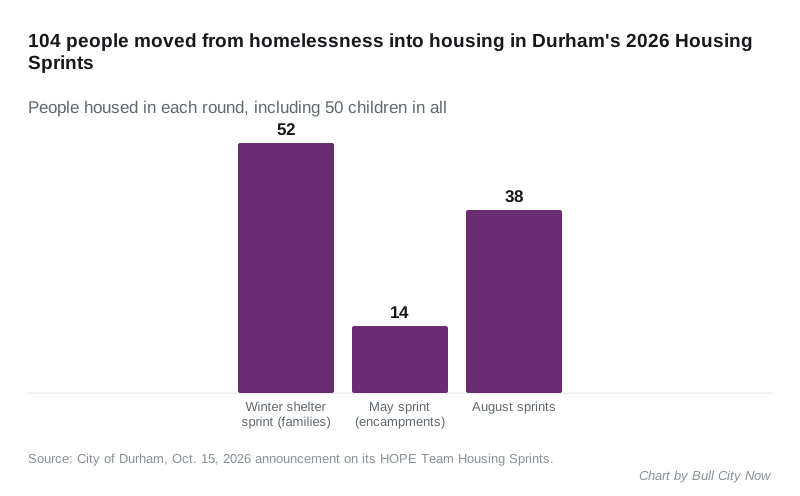
City-led Housing Sprints have moved 104 people out of homelessness in Durham this year, 50 of them children. 49 of 50 households are still housed. Next sprint: Nov. 2.
A City of Durham program has moved 104 people from homelessness into housing this year. Fifty of them are children.
They were housed through three rounds of “Housing Sprints” run by the city’s HOPE Team, the city announced Thursday. Most people went from their first paperwork to getting keys within 30 days.
The sprints have housed 50 households in all. Forty-nine of them, or 98%, are still housed, the city said.
“Sprints are the system at full speed. February showed the model could work; reaching 104 shows it can begin to scale,” said Anise Vance, assistant director of the city’s Community Safety Department.
The next sprint begins Monday, Nov. 2.
Updated Nov. 2: City Manager Bo Ferguson’s Oct. 30 City Connect newsletter gives the next sprint’s start as Nov. 2, not Nov. 1 as the city first said. It counts four sprints so far, treating the August round as two, and repeats the totals: more than 100 people, including 50 children, with 49 of 50 households still housed. It adds that a city policy on encampments is expected to come before the City Council in early 2027. The city has not said which group the November sprint will focus on.
How a sprint works
Each sprint is a four- to six-week push aimed at one group, such as families in a shelter or people living in an encampment. The city describes five parts:
- Everyone is connected through Entry Point Durham, the intake team for people facing homelessness, often with help from the city’s HEART street outreach teams.
- Nonprofits provide the housing support. The city named Families Moving Forward, Housing for New Hope, Family Promise of the Triangle, HOM Inc. and Urban Ministries of Durham.
- Landlords agree to rent to people coming out of homelessness.
- Flexible money covers move-in costs and the small bills that otherwise hold up a move.
- Each household gets a case manager who starts before move-in and stays involved afterward.
The rounds so far
| Sprint | Who it was for | Housed | Still housed |
|---|---|---|---|
| Winter shelter sprint | Families in shelter | 14 households, 52 people, including 34 children (goal: 10 households) | 13 of 14 households six months later |
| May sprint | Adults living in encampments | 14 adults | One more participant is still in case management |
| August sprints | Single adults and families | 38 people: 13 adults on their own and nine families of 25 people, including 16 children | Two more people and five more households are in the process |
The city said one participant moved from intake into his own apartment in 27 days, after nearly four years living outside.
Why it matters
The city calls the 104 the first major result of its strategic framework to make homelessness rare and brief.
The HOPE Team, short for Housing Opportunities and Pathways Engagement, is part of the Community Safety Department. It works with Durham County, the local Continuum of Care, nonprofits and landlords, the city said.
The city’s announcement does not say what the sprints cost or how many people remain homeless in Durham. We will add both figures if the city publishes them.
What it means for you
- If you or your family need shelter: go to Entry Point Durham in the Durham County Human Services Building, 414 E. Main St., 8 a.m. to 5 p.m. weekdays. The intake line, 984-287-8313, answers until 8 p.m. on weekdays. Entry Point is the only way into the shelters at Urban Ministries of Durham and Families Moving Forward, the city says.
- If you are fleeing violence: call the Durham Crisis Response Center’s 24-hour line at 919-403-6562. In an emergency, call 911.
- If you are a landlord: the city is looking for landlords willing to rent to people leaving homelessness as the November sprint gets underway. Email the HOPE Team at hope@durhamnc.gov.
- To follow City Hall: see who to call at City Hall.
Have your say