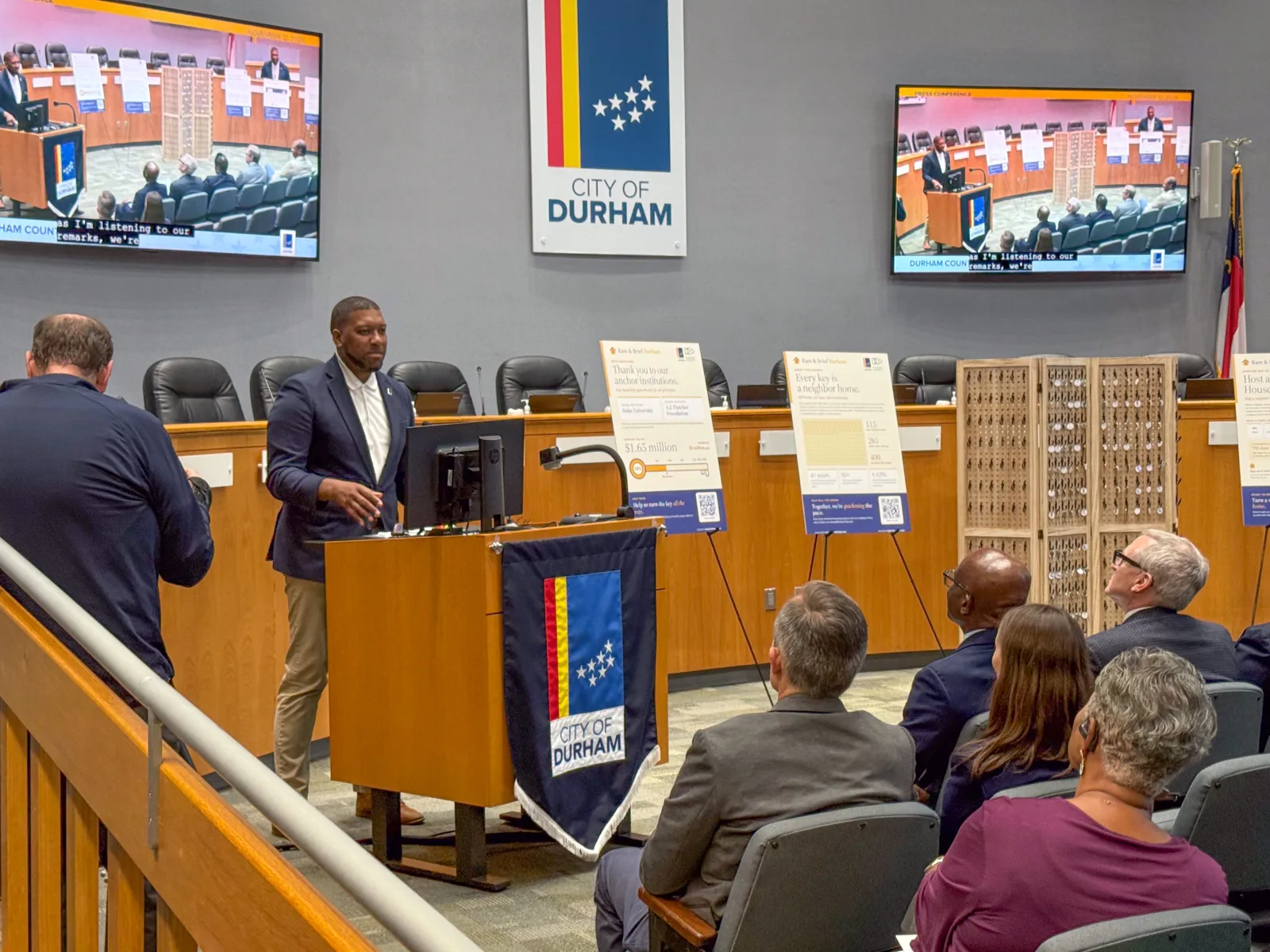
Duke and the A.J. Fletcher Foundation are giving $1.65 million to help about 200 more Durham households into homes. The money pays deposits, utility debt and back rent.
Duke and the A.J. Fletcher Foundation are putting $1.65 million into the fund Durham uses to move people out of homelessness and into homes. The city announced the gift Thursday, Nov. 12. It expects the money to help about 200 more households find stable housing.
Duke is giving $1 million and the foundation $650,000. The details are in the city’s announcement.
Where the money goes
The gifts go into Durham’s Flexible Housing Assistance Fund. The city calls it the financial engine behind its Housing Sprints, short pushes in which outreach workers, nonprofits and landlords move households into homes within weeks.
The fund pays the costs that can stop a move at the last step:
- security deposits
- utility debt
- application fees
- back rent owed on an earlier home
- short-term rental help
“For a family leaving shelter, the final barrier is often a security deposit, utility payment, or another relatively small expense,” said Tasha Melvin, executive director of Families Moving Forward.
What the sprints have done so far
Since February, the Housing Sprints have helped 115 people move into stable homes, the city said. More than 50 of them were children. Most moved within 30 days, and 98% are still housed.
The current sprint started Nov. 1. Led by the city’s HOPE Team, it aims to house 30 households, including 15 families, by the end of the year. Its partners are:
- Families Moving Forward
- Housing for New Hope
- Family Promise of the Triangle
- Urban Ministries of Durham
- HOM Inc.
Our earlier story covers the first Housing Sprints and the people they housed.
A $5 million goal
The $1.65 million is the first money toward a goal of $5 million in private and philanthropic support, the city said. It is meant to sit alongside public money. The City of Durham and Durham County have put more than $8 million into homelessness services and housing this year, more than $5 million of it new.
Both governments adopted a plan this year called the Strategic Framework to Make Homelessness Rare & Brief. It aims to make homelessness rare, brief and nonrecurring by 2031. Its next milestone is 400 people housed by June 2027.
“This is about more than housing. It is about restoring stability, creating opportunities, and ensuring our neighbors have the support and resources they need to move forward,” Mayor Leonardo Williams said.
Dr. David Zaas, chief executive officer of Duke University Health System, said: “Health begins at home. It is hard to recover from an illness, manage a chronic condition, or stay connected to care when you do not know where you will sleep tonight.”
Michael Goodmon, a member of the A.J. Fletcher Foundation board, said the foundation had seen “encouraging evidence that Durham’s approach is making a meaningful difference.”
What it means for you
- If you want to know how the plan works: the city and county explain it on the Rare & Brief Durham website.
- If you are a landlord: the city is looking for landlords willing to rent to a household in the sprint. Email the HOPE Team at hope@durhamnc.gov.
- If you want to give: businesses, foundations and residents can donate to the Flexible Housing Assistance Fund. Congregations, neighborhood groups and businesses can also host a Durham Housewarming, which supplies move-in essentials for a new home.
Have your say